
February 23, 2026
ahmedaffan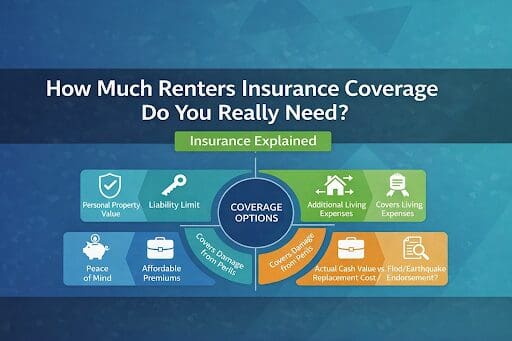
How Much Renters Insurance Coverage Do You Really Need?
If you’re renting an apartment in Los Angeles, a townhouse in Houston, or a studio in Chicago, one question deserves a real answer: How much renters insurance do you actually need? Not a vague range. Not a one-size-fits-all number. A real answer based on what you own, where you live, and what could go wrong.
Here’s a sobering reality: according to the Insurance Information Institute, only 55% of U.S. renters have renters insurance, meaning nearly 45% of renters, tens of millions of people, are one accident, fire, or theft away from financial disaster. And of those who do have coverage, many are underinsured without knowing it.
This guide breaks down exactly how much renters insurance coverage you need, what each type of coverage does, and how to avoid the most common and costly mistakes renters make when choosing a policy.
What Does Renters Insurance Actually Cover?
Before figuring out how much coverage you need, it helps to understand what a standard renters insurance policy includes. Most policies have four core components.
Personal property coverage pays to repair or replace your belongings, furniture, electronics, clothing, appliances, and more if they’re damaged or stolen due to a covered event like fire, theft, vandalism, or water damage from a burst pipe.
Liability coverage protects you financially if someone is injured in your home or if you accidentally damage someone else’s property. It can also cover legal defense costs if you’re sued.
Loss of use (additional living expenses) coverage picks up the tab for temporary housing, meals, and transportation if your rental becomes uninhabitable after a covered disaster.
Medical payments coverage handles minor medical bills for guests injured in your home, regardless of who’s at fault—typically up to $1,000 or $2,000 per incident.
What renters insurance does not cover: flooding, earthquakes, sinkholes, and most pest damage. If you’re renting in a flood-prone area like Miami or New Orleans, you’ll want a separate flood insurance policy through the National Flood Insurance Program (NFIP) or a private insurer.
How Much Personal Property Coverage Do You Need?
The average renter’s belongings are worth roughly $20,000, according to Investopedia and the Insurance Information Institute, but that number can swing dramatically depending on your lifestyle. A renter in a furnished studio in Dallas has very different needs than someone with a home office full of equipment in Seattle.
Most standard renters insurance policies offer personal property limits ranging from $15,000 to $100,000 or more. For most renters, $30,000 is a reasonable starting point. However, if you have a home office, expensive hobbies, or a wardrobe worth several thousand dollars, you may need to push that limit higher.
How Much Liability Coverage Do You Need?
Liability is the coverage most renters underestimate, and it’s where a single accident can become a financial catastrophe.
The typical renter’s insurance policy offers $100,000 in liability coverage, and for most renters this amount is a solid starting point. But whether it’s truly sufficient depends on your circumstances. If you frequently host guests, own a dog, or have assets worth more than $100,000, you should seriously consider bumping that limit to $300,000 or even $500,000.
If your net worth is significant, consider pairing your renters policy with an umbrella insurance policy for an extra $1 million or more in liability protection. According to the Insurance Information Institute, umbrella policies generally cost around $150 to $300 per year, a small price for dramatically expanded protection.
How Much Loss of Use Coverage Do You Need?
Loss of use coverage, also called additional living expenses (ALE), is often set automatically at 20% to 30% of your personal property limit. So if you have $30,000 in personal property coverage, you’d typically have $6,000 to $9,000 in loss of use coverage.
Think about what it would actually cost you to live temporarily in your city. A hotel in Atlanta or Phoenix runs $80 to $200 per night. Add food, laundry, and extra transportation, and the costs pile up quickly. If your rental requires major repairs and you’re displaced for three to six weeks, a low ALE limit could leave you footing a significant portion of the bill.
Make sure your loss of use coverage reflects realistic costs for temporary housing in your specific metro area, not a national average. Renters in high-cost cities like New York, San Francisco, or Boston should be especially careful here.
Renters Insurance Coverage: A Quick Reference Table
| Coverage Type | Typical Range | Recommended Minimum | Who Needs More |
| Personal Property | $15,000 – $100,000+ | $30,000 | Tech professionals, collectors, home office workers |
| Liability | $100,000 – $500,000 | $100,000 | Pet owners, frequent hosts, high-net-worth renters |
| Loss of Use | 20%–30% of property limit | 20% of property limit | Renters in high-cost cities like NYC, SF, Boston |
| Medical Payments | $1,000 – $5,000 | $1,000 | Anyone who regularly has guests |
| Scheduled Property | Per item value | Full replacement value | Jewelry, instruments, cameras, collectibles |
What Affects the Cost of Renters Insurance?
The good news: renters insurance is one of the most affordable types of insurance you can buy. According to data verified by Simply Insurance and MoneyGeek, the average renter’s insurance policy costs approximately $187 per year, or about $15.58 per month, as of 2025. For most renters, that’s less than a monthly streaming subscription.
Several factors influence your specific rate. Your location matters enormously. According to the Insurance Information Institute, renters in Mississippi, Louisiana, and Alabama pay the highest premiums on average due to severe weather risk, while renters in North Dakota, South Dakota, and Minnesota enjoy the lowest rates. A renter in New Orleans will pay meaningfully more than one in Denver, even with identical coverage amounts.
Your credit score plays a role in most states. Better credit typically means lower premiums. Note that California, Hawaii, Maryland, Michigan, Massachusetts, Oregon, and Utah prohibit insurers from using credit scores for pricing purposes.
Common Mistakes Renters Make With Their Coverage
Many renters underinsure their personal property by guessing at their belongings’ value and choosing too low a limit. Taking an actual room-by-room inventory almost always reveals a total higher than expected.
According to verified industry research, approximately 62% of renters are unaware that their landlord’s insurance does not cover their personal belongings, leaving them exposed to significant financial loss from fire, theft, or water damage. This is one of the most important facts every renter in the country needs to understand.
Finally, many renters assume their standard policy covers floods. It does not. Renters in flood-prone areas like Tampa Bay or Houston’s Harris County need a separate flood policy.
For a comprehensive look at your coverage options Thrifty Insurance’s Renters Insurance page is a great place to start comparing policies tailored to your situation.
Does Your Landlord Require Renters Insurance?
More landlords across the country, from major apartment complexes in Phoenix to boutique buildings in Brooklyn, are making renters insurance a lease requirement. Even when it’s not mandatory, getting covered is one of the smartest financial decisions a renter can make.
If your landlord requires it, they’ll typically specify a minimum liability limit, usually $100,000, and ask to be listed as an “additional interested party” on your policy. This simply means they receive notifications if your policy lapses. It does not give them any claim on your coverage.
According to the U.S. Census Bureau and the Insurance Information Institute, in 2024 34.8% of all occupied housing units in the United States were renter-occupied, representing tens of millions of households, many of whom still lack adequate protection.
How Thrifty Insurance Helps Renters Find the Right Coverage
Figuring out exactly how much renters insurance you need doesn’t have to be a solo mission and it shouldn’t be a guessing game. At Thrifty Insurance, the focus is on helping renters across the country find coverage that’s genuinely matched to their situation, not just the cheapest policy on the shelf.
Thrifty works with multiple top-rated insurance carriers, which means you get real options and real comparisons,mission, not just one company’s quote. Whether you’re a first-time renter in Nashville looking for basic coverage, a remote worker in Austin who needs higher limits for home-office equipment, or a pet owner in Denver concerned about liability, Thrifty’s team can walk you through the right coverage levels, explain the difference between ACV and replacement cost, and help you bundle policies for maximum savings.
The process is straightforward: share some basic information about your rental and your belongings, and Thrifty does the legwork of comparing rates and coverage across carriers. No pressure, no jargon, just honest guidance toward a policy that actually protects you.
Conclusion
Renters insurance is one of the most underutilized yet most powerful financial tools available to American renters today. According to the U.S. Census Bureau and the Insurance Information Institute, 34.8% of all occupied housing units in the U.S. are renter-occupied as of 2024, yet only 55% of those renters carry renters insurance, leaving nearly half the renting population fully exposed to financial loss.
The numbers make the risk impossible to ignore: dog bite liability alone averaged $69,272 per claim in 2024, according to the Insurance Information Institute and State Farm, up 86% over the past decade, and 62% of renters still don’t realize their landlord’s policy offers them zero protection. A standard renters insurance policy costs as little as $187 per year, less than most people spend on a single dinner out, yet it covers your personal belongings, protects you from devastating liability claims, and pays for temporary housing if disaster strikes. Whether you’re renting in Los Angeles, Atlanta, Denver, or anywhere in between, the right renters insurance coverage isn’t a luxury; it’s a necessity.
FAQs
Is renters insurance required by law in the U.S.?
No U.S. state legally requires renters insurance. However, many landlords across the country include it as a mandatory condition in their lease agreements.
How much does renters insurance cost on average?
According to Simply Insurance and MoneyGeek, the average renter’s insurance policy costs approximately $187 per year, or about $15.58 per month, as of 2025.
Does renters insurance cover my personal belongings outside my home?
Yes—most standard renters insurance policies cover personal belongings even when they’re outside your home, such as items stolen from your car or lost while traveling.
What is the difference between actual cash value and replacement cost coverage?
Actual cash value pays what your item is worth today after depreciation, while replacement cost coverage pays what it actually costs to buy a brand-new equivalent item at current market prices.
Does my landlord’s insurance cover my belongings if there’s a fire or theft?
No, your landlord’s insurance only covers the building structure itself. According to industry research, 62% of renters are unaware that their personal belongings are completely unprotected without their own renters’ insurance policy.
Categories: Blog