
February 19, 2026
ahmedaffan
Top 7 Benefits of Renters Insurance Everyone Should Know
If you are renting an apartment in Los Angeles, a home in Phoenix, or a condo in Dallas, there is one question you need to ask right now: what happens to everything you own if a fire breaks out, a burglar breaks in, or a guest gets injured inside your rental? Your landlord’s policy protects the building, not a single item that belongs to you. That is exactly where renters insurance steps in, and the benefits go far beyond what most people expect.
According to the Insurance Information Institute (III), 57% of renters in the United States now have a renters insurance policy, up from 42% in 2018, 37% in 2014, and just 31% in 2012. That growth is encouraging,but it still means nearly half of all renters in America are completely unprotected. According to MoneyGeek, about 55% of U.S. renters, roughly 61 million people, currently carry renters insurance, while 45% remain uninsured, leaving millions of households exposed to devastating financial loss.
What Is Renters Insurance, and Who Needs It?
Renters insurance, also known as an HO-4 policy, is designed specifically for people who rent their homes, apartments, or condos. It does not cover the physical structure of the building that your landlord handles. Instead, it covers your personal belongings, protects you against liability claims, and pays for temporary living expenses if your rental becomes uninhabitable.
According to U.S. Census Bureau and Arbor Realty Trust data, rental households in the United States hit a new high of 45.3 million in 2024, accounting for more than half of all U.S. household growth that year. Rental households grew by 1.9% in 2024, more than double the 0.7% growth rate for owner-occupied homes. Whether you are a college graduate renting your first apartment in Austin, a young family renting in Chicago, or a professional renting a condo in San Diego, renters insurance is one of the smartest and most affordable financial safety nets available to you.
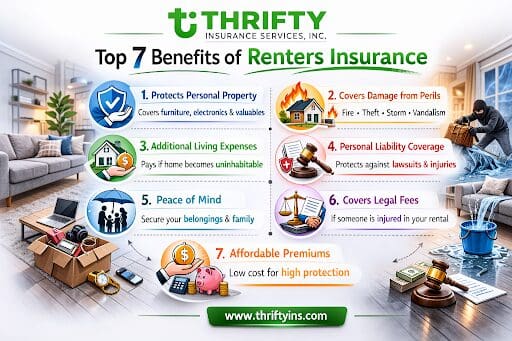
The Top 7 Benefits of Renters Insurance
Benefit 1: Your Personal Belongings Are Protected From Theft, Fire, and More
The most fundamental benefit of renters’ insurance is protection for your personal property. Your laptop, smartphone, television, furniture, clothing, kitchen appliances, and everything else you own are covered against a wide range of risks, including theft, fire, windstorm, vandalism, and certain types of water damage.
Most renters do not realize how much their belongings are actually worth until they add it all up. According to Investopedia and widely cited insurance industry data, the average renter has approximately $20,000 in personal belongings. Bankrate confirms that renters insurance commonly covers around $30,000 in personal property under a standard policy, which is the range most renters need to be fully protected.
Benefit 2: Liability Coverage Shields You From Costly Lawsuits
Personal liability coverage is one of the most valuable and most overlooked components of renters insurance. If someone is injured inside your rental in Denver or your dog bites a neighbor in Houston, you could be held legally responsible for their medical bills, lost wages, and legal fees. Without insurance, that exposure can quickly reach tens of thousands of dollars.
A standard renters insurance policy typically includes $100,000 in liability protection as its baseline, according to State Farm. Most insurers also offer options of $300,000 and $500,000 in coverage, as confirmed by Progressive. According to NerdWallet, increasing your liability limit from $100,000 to $300,000 typically adds only about $1 per month to your premium, an almost negligible cost for significantly stronger financial protection.
Benefit 3: Loss of Use Coverage Pays for Temporary Housing
Imagine a fire starts in the unit next to yours in Chicago. Your apartment sustains smoke and water damage and is declared uninhabitable. Where do you live? Who pays for your hotel? If you have renters insurance, your policy does cover loss of use, also called additional living expenses (ALE).
This benefit covers the cost of a hotel, temporary rental, meals, and other necessary expenses above your normal living costs while your home is being repaired. In cities like San Francisco, Seattle, or New York City, temporary housing costs can easily run hundreds of dollars per night. Without this coverage, every one of those costs comes directly out of your pocket.
Benefit 4: Off-Premises Theft Your Belongings Are Covered Away From Home
One of the most surprising benefits of renters insurance is that your personal property coverage often follows your belongings wherever you go. If your laptop is stolen from your car in a parking lot in Miami, your camera goes missing while you are traveling in Boston, or your bike is taken outside a coffee shop in Portland, many renters insurance policies will cover those losses under off-premises theft protection.
According to Travelers Insurance, renters insurance can cover personal belongings lost or stolen both at home and away from home, including items stolen out of a vehicle or taken while you are traveling. This makes renters insurance especially valuable for remote workers, frequent travelers, or anyone who regularly commutes with expensive electronics or equipment.
Benefit 5: Renters Insurance Is Remarkably Affordable
One of the biggest misconceptions about renters insurance is that it is expensive. The reality is quite the opposite; renters insurance is one of the most affordable insurance products on the market today.
According to The Zebra, citing the latest III data, the average cost of renters insurance nationally is $171 per year, or about $15 per month. State Farm confirms an average of about $15 per month for up to $35,000 in personal property coverage. Progressive’s 2024 data shows their renters insurance costs range from $13 to $27 per month depending on the state and coverage selected.
Renters insurance premiums have actually declined 9% since 2013, according to The Zebra, making it even more affordable than it was a decade ago. The table below shows how premiums vary by state:
| State | Average Annual Premium | Source |
| Mississippi | ~$252 | The Zebra / MoneyGeek |
| Louisiana | ~$243 | III / NAIC |
| National Average | ~$171 | III / The Zebra |
| North Dakota | ~$116 | AgileRates / III |
| Common Deductible | $500 | Insurance Information Institute |
| Common Liability Minimum | $100,000 | State Farm / Progressive |
| Most Common Property Coverage | $20,000–$30,000 | MoneyGeek / Bankrate |
According to a 2022 study cited by SmartMove, 75% of landlords who require renters insurance do so because tenants who carry insurance are far less likely to create financial disputes after a loss which means having a policy benefits both renters and their landlords.
For renters in California, competitive pricing is available across many carriers. As an independent insurance agency, Thrifty Insurance Services shops multiple top-rated carriers to find you the best rate whether you are in Upland, Rancho Cucamonga, Riverside, or anywhere across the Inland Empire.
Benefit 6: Protection Against Fire, Windstorm, and Other Named Perils
A standard renter’s insurance policy protects your personal property against a wide list of named perils, including fire, smoke damage, lightning, windstorm, hail, explosion, theft, vandalism, and certain types of sudden and accidental water damage. For renters in high-risk regions such as tornado-prone areas of Texas and Oklahoma or wildfire-adjacent regions of Arizona and California, this coverage is especially critical.
According to the Insurance Information Institute, about one in 430 insured homes has a property damage claim related to fire and lightning each year. Additionally, about one in 36 insured homes has a property damage claim related to wind or hail, and about one in 67 has a claim caused by water damage or freezing. These are not rare events; they happen to real people every day across the United States, and renters without insurance are left to absorb the full cost themselves.
Benefit 7: Renters Insurance Can Make You a More Competitive Tenant
In tight rental markets like San Francisco, Washington, D.C., and New York City, landlords often have multiple qualified applicants for a single unit. A growing number of landlords across the country now require tenants to show proof of renters insurance before signing a lease. According to SmartMove, 75% of landlords who require tenants to carry renters insurance do so because it significantly reduces financial disputes and property damage liability issues.
Even when insurance is not required, presenting proof of a renter’s policy demonstrates financial responsibility and makes you stand out as a prepared, reliable tenant. In competitive rental markets, that can be the deciding factor between landing your ideal apartment and losing it to another applicant.
How Thrifty Insurance Services Helps Renters Get the Right Coverage
At Thrifty Insurance Services, Inc., headquartered in Upland, California, we help renters across the Inland Empire, including Rancho Cucamonga, Fontana, Ontario, and Riverside, as well as renters throughout California, Arizona, Colorado, Utah, and Texas, find the right coverage at the right price.
As an independent insurance agency, we are not tied to any single carrier. That means we compare rates and coverage options across multiple top-rated insurance companies to find you the best possible policy. Whether you need a basic plan or a more comprehensive policy with higher liability limits and replacement cost coverage, our licensed agents walk you through every option without the confusing jargon.
Final Thoughts
At Thrifty Insurance, renters insurance is one of those policies that feels unnecessary right up until the moment you desperately wish you had it. A break-in, a kitchen fire, an injured guest, or a burst pipe in the unit above yours—any one of these events can turn into a major financial crisis without the right coverage in place.
With 45% of U.S. renters still unprotected according to MoneyGeek and the Insurance Information Institute and 45.3 million renter households across the country (U.S. Census Bureau / Arbor Realty Trust), the coverage gap remains very real. For as little as $15 per month, you can close that gap and protect your belongings, your finances, and your peace of mind.
FAQs
What does renters insurance cover?
Renters insurance covers your personal belongings against theft, fire, windstorm, and vandalism. It also includes personal liability protection and additional living expenses if your rental becomes uninhabitable.
How much does renters insurance cost per month?
According to the Insurance Information Institute, the average cost of renters insurance is approximately $171 per year, or about $15 per month. Costs vary by state, coverage amount, and deductible selected.
Does my landlord’s insurance cover my belongings?
No — your landlord’s insurance covers only the physical building structure, not your personal property. You need your own renters insurance policy to protect your belongings and cover your personal liability.
How much renter’sNo your insurance coverage do I need?
Most renters need between $20,000 and $30,000 in personal property coverage, according to Bankrate and MoneyGeek. A standard liability limit of $100,000 is recommended as a minimum, with $300,000 available for stronger protection.
Is renters’ insurance required by law?
Renters insurance is not required by law in any U.S. state. However, many landlords across cities like Los Angeles, Chicago, and New York require tenants to carry a policy as a condition of their lease agreement.
Categories: Blog