
February 27, 2026
ahmedaffan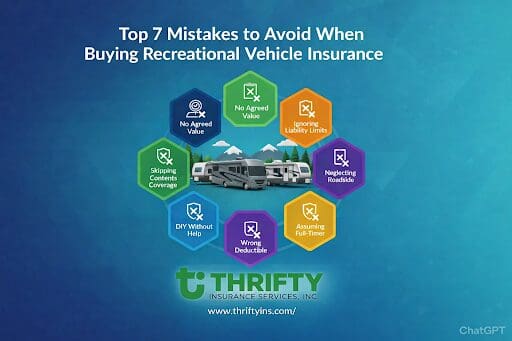
Top 7 Mistakes to Avoid When Buying Recreational Vehicle Insurance
Recreational vehicle ownership is one of the most beloved American traditions. According to the RV Industry Association (RVIA), a total of 333,733 RV units were shipped across the United States in 2024, a 6.6% increase over 2023. From the desert highways of Arizona and Texas to the mountain roads of Colorado and the coastal routes of California, more Americans than ever are hitting the open road in motorhomes, travel trailers, fifth wheels, and camper vans. According to Go RVing’s 2025 Demographic Study, 8.1 million U.S. households currently own an RV, and 16.9 million additional households plan to purchase one within the next five years.
But with that freedom comes real financial risk. Buying the wrong recreational vehicle insurance, or worse, no proper coverage at all, can turn your dream road trip into a financial disaster. Whether you are a first-time buyer in Upland, California, or a seasoned traveler crossing through Utah and Texas, the seven mistakes below are the most common and the most costly ones RV owners make when buying insurance.
Mistake 1: Assuming Your Auto Insurance Covers Your RV
This is the single most expensive misunderstanding among new RV buyers. Many people assume that because a motorhome is a motorized vehicle, their personal auto policy will protect it fully. It will not. A standard auto policy is built for passenger cars, not a vehicle that also functions as a living space with its own liability exposures, personal property, and long-term parking risks.
For towable RVs like fifth wheels and travel trailers, your auto policy may offer a thin layer of liability protection while the trailer is being towed. But the moment you unhitch it at a campsite in Colorado or park it for the season in Arizona, that coverage disappears entirely. Theft of personal belongings inside the RV, physical damage to the unit itself, and any liability if someone is injured near your parked vehicle all go unprotected. Always secure a dedicated recreational vehicle insurance policy before you ever drive off the dealership lot.
Mistake 2: Choosing Actual Cash Value Instead of Agreed Value Coverage
How your insurer values your RV at the time of a total loss can mean a difference of tens of thousands of dollars. Most entry-level policies default to Actual Cash Value (ACV), meaning the insurer pays what your RV is worth at claim time after depreciation is applied. RVs depreciate quickly. A new motorhome can lose 20% or more of its value within the first year alone.
Agreed value coverage, on the other hand, locks in a payout amount that you and the insurer agree upon at the start of the policy. If your Class A motorhome is totaled on a highway in Texas or severely damaged in a hailstorm while parked in Arizona, you receive the full agreed amount with no depreciation deducted. While agreed-value policies typically carry a slightly higher premium, the financial protection they offer is significantly stronger, especially for newer or high-value RV units. Before you sign any policy, always ask your agent which valuation method applies.
Mistake 3: Skipping Full-Timer Coverage If You Live in Your RV
The full-time lifestyle has grown dramatically across the United States. According to Go RVing’s 2025 Demographic Study, 22% of RV owners in the 18 to 34 age group now use their RV as a primary or semi-primary residence, up from just 8.47% in 2018. If your RV is your home and not just a vacation vehicle, a standard RV policy simply is not designed to protect you.
Standard RV policies are built for recreational use, meaning weekend trips and seasonal travel. When your RV becomes your permanent or primary residence, you need full-time coverage, which works much like a homeowners insurance policy adapted for life on the road. It typically includes personal liability protection, coverage for your personal belongings, and loss of use benefits if your RV becomes uninhabitable after a covered event. Without it, a single liability claim from a visitor injured at your campsite in Utah or California could expose your personal savings and assets directly. If you are living the full-time lifestyle, speak with an agent about upgrading your Recreational Vehicle Insurance policy to include full-time endorsements built for your situation.
Mistake 4: Declining Roadside Assistance Coverage
RV breakdowns are not just inconvenient; they are extraordinarily expensive. A Class A motorhome can weigh between 13,000 and 50,000 pounds and requires a specialized heavy-duty tow truck that most standard roadside companies cannot handle. According to Good Sam’s towing cost data, professional RV towing runs between $135 and $150 per hour. An 80-mile tow of a large motorhome can cost $450 to $600 or more, and that number rises sharply in remote areas of Nevada or Montana where specialized equipment is harder to source.
Comprehensive RV roadside assistance typically covers towing, flat tire service, battery jump-starts, fuel delivery, and lockout service. Many plans also include trip interruption coverage, which reimburses hotel stays and meal costs if your RV becomes disabled far from home. For the small additional premium this coverage costs, it is one of the highest-value add-ons available in any RV insurance policy. Do not decline it simply to lower your monthly bill.
Mistake 5: Forgetting to Cover Personal Property Inside Your RV
Your RV is more than a vehicle. It is a home on wheels filled with personal belongings. Laptops, cameras, fishing gear, bicycles stored in the garage bay, satellite equipment, custom appliances, and jewelry all add up quickly. Many RV owners carry several thousand dollars in personal property, yet their policy either excludes personal property coverage entirely or applies a very low limit that leaves most of their belongings exposed.
Your homeowners insurance may cover some personal property away from home, but that coverage is typically limited to a small percentage of your primary dwelling coverage. If you rent and do not carry a renters insurance policy, you could have zero coverage for items stolen from or damaged inside your RV. Before your next trip through California or Arizona, review your existing policies carefully and schedule high-value items through your RV insurer or a separate personal property floater to make sure everything you bring on the road is fully covered.
Mistake 6: Not Shopping Multiple Carriers and Comparing Quotes
RV insurance premiums vary dramatically from one carrier to another because different insurers weigh risk factors such as vehicle type, age, usage, storage location, and driving history very differently. A Class B camper van owner in California could see annual premiums ranging from $500 to well over $2,000 depending on the insurer, coverage levels, and applicable discounts. Buying the first policy you are quoted is one of the fastest ways to overpay for coverage year after year.
The most effective approach is working with an independent insurance agent who has access to multiple top-rated carriers and compares options on your behalf. As an independent agency serving clients across California, Arizona, Colorado, Utah, and Texas, Thrifty Insurance Services shops the market specifically to find the right fit for your RV type, lifestyle, and budget. Visit thriftyins.com to request a free quote and see exactly how much you could save simply by comparing carriers rather than accepting the first option presented.
Mistake 7: Ignoring State-Specific Insurance Requirements
Every U.S. state sets its own minimum liability insurance requirements for motorized RVs, and these requirements can vary significantly from your home state. If you are a California resident who winters in Arizona or regularly travels through Texas and Utah, you must understand the specific requirements of every state you plan to drive through. Driving uninsured in any state can result in fines, license suspension, and full personal liability for damages caused in an accident.
Towable RVs such as travel trailers and fifth wheels generally do not require separate liability insurance in most states while being towed, as they fall under the towing vehicle’s policy while in motion. But the moment you park and unhitch, that protection ends. State regulations around campsite liability, slide-out coverage, and requirements for stored trailers differ widely across the country. Review your state’s minimum requirements annually, and especially before any multistate trip. An independent agent familiar with multi-state RV policies can help ensure you remain fully compliant everywhere your travels take you.
Quick Reference: All Mistakes at a Glance
| Mistake | Risk | What It Costs You | The Fix |
| Relying on auto insurance for RV | High | Denied claims, zero coverage when parked | Get a dedicated RV policy |
| Choosing ACV over Agreed Value | High | Thousands lost to depreciation at claim | Choose Agreed Value coverage |
| Skipping full-timer coverage | High | No liability or belongings protection | Add full-timer endorsement |
| Declining roadside assistance | High | $450–$600+ per tow out of pocket | Add roadside to your policy |
How Thrifty Insurance Services Helps You Get It Right
Based in Upland, California, and licensed to serve clients across California, Arizona, Colorado, Utah, and Texas, Thrifty Insurance Services has built its reputation on straightforward, personalized guidance. As an independent insurance agency, we are not tied to any single carrier. We work for you, comparing rates and coverage options across dozens of top-rated insurers to find the best match for your specific RV, how you use it, and your budget.
Our team understands that no two RV owners are exactly alike. A weekend camper heading into the mountains of Colorado has very different needs from a full-timer living on the road year-round in Texas or Arizona. That is why we take the time to ask the right questions, review your existing policies, identify any coverage gaps, and build a protection plan that keeps you worry-free wherever the road takes you. We walk every client through policy details in plain, everyday language, not insurance jargon.
Pre-Purchase RV Insurance Checklist
Before signing any RV insurance policy, ask your agent these key questions. Is this policy RV-specific or simply a modified auto policy? Does it use Agreed Value or Actual Cash Value for a total loss? Is full-timer coverage available and included if needed? What does the roadside assistance plan specifically cover? How is personal property inside the RV protected, and up to what limit? Are there discounts available for safe driving history, completing an RV safety course, or bundling multiple policies? Does this policy meet the minimum liability requirements for every state you plan to travel through?
Getting clear, confident answers to each of these questions before you buy is the surest way to avoid the costly surprises that catch so many RV owners off guard. With 16.9 million U.S. households planning to enter the RV market within the next five years, according to Go RVing’s 2025 study, the demand for clear and accessible RV insurance guidance has never been higher. Do not let the excitement of buying a new RV rush you past the most important step of getting your coverage right.
Conclusion
A Recreational Vehicle Insurance policy is one of the most meaningful purchases many Americans will ever make and also one of the most misunderstood when it comes to proper coverage. From choosing the right valuation method and understanding full-time endorsements to staying compliant with state laws across California, Arizona, Texas, Colorado, and Utah, every decision in your recreational vehicle insurance policy matters more than most buyers realize. A well-chosen policy not only protects your investment but also ensures peace of mind while traveling. Avoiding the seven common mistakes in this article puts you in a far stronger position to enjoy the open road with genuine confidence and security.
FAQs
Q1. Is RV insurance required by law in the US?
Yes, most US states require minimum liability insurance for motorized RVs, just like a regular vehicle. Towable RVs like travel trailers are typically covered under the towing vehicle’s auto policy while in motion.
Q2. How much does RV insurance cost per year in the US?
According to Progressive, RV insurance costs an average of $502 per year for travel trailers and $848 per year for motorhomes, though rates vary based on RV type, usage, and driving history.
Q3. Does my homeowners insurance cover my RV?
No, standard homeowners insurance does not cover your RV for liability or collision. You need a separate, dedicated RV insurance policy for full protection.
Q4. What is the difference between Agreed Value and Actual Cash Value in RV insurance?
Agreed Value pays a fixed amount you and the insurer set upfront with no depreciation deducted. Actual Cash Value pays what the RV is worth at claim time, after depreciation is applied.
Q5. Does RV insurance cover personal belongings inside the RV?
Some RV policies include limited personal property coverage, but many do not cover belongings fully. You may need a separate endorsement or floater to protect electronics, gear, and valuables inside your RV.
Categories: RV